Publications
Selected papers in AI for Software Engineering, program repair, and code generation.
2025
-
 AutoPLC: Generating Vendor-Aware Structured Text for Programmable Logic ControllersDonghao* Yang, Aolang* Wu, Tianyi* Zhang, and 6 more authorsIn 2025 40th IEEE/ACM International Conference on Automated Software Engineering (ASE), Seoul, Korea, Republic of, 2025
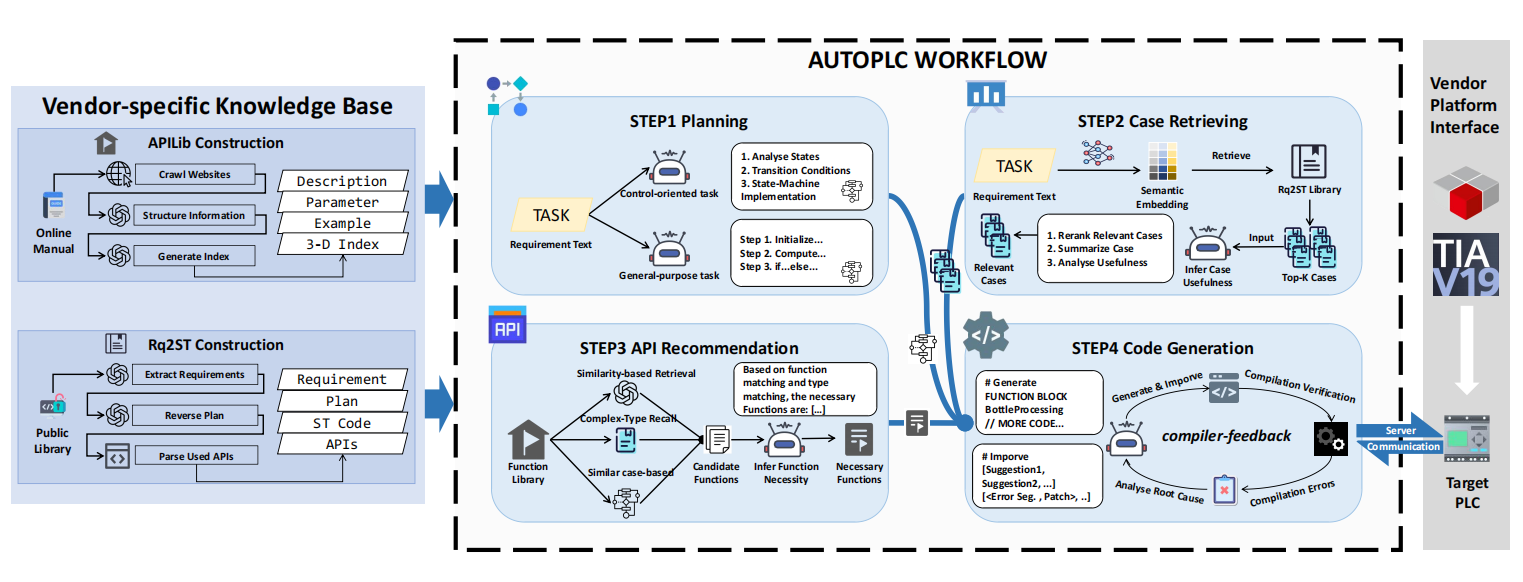
Among the programming languages for Programmable Logic Controllers (PLCs), Structured Text (ST) is widely adopted for industrial automation due to its expressiveness and flexibility. However, major vendors implement ST with proprietary extensions and hardware-specific libraries - Siemens’ SCL and CODESYS’ ST each differ in syntax and functionality. This fragmentation forces engineers to relearn implementation details across platforms, creating substantial productivity barriers. To address this challenge, we developed AutoPLC, a framework capable of automatically generating vendor-aware ST code directly from natural language requirements. Our solution begins by building two essential knowledge sources tailored to each vendor’s specifications: a structured API library containing platform-exclusive functions, and an annotated case database that captures real-world implementation experience. Building on these foundations, we created a four-stage generation process that combines step-wise planning (enhanced with a lightweight natural language state machine support for control logic), contextual case retrieval using LLM-based reranking, API recommendation guided by industrial data, and dynamic validation through direct interaction with vendor IDEs. Implemented for Siemens TIA Portal and the CODESYS platform, AutoPLC achieves 90%+ compilation success on our 914-task benchmark (covering general-purpose and process control functions), outperforming all selected baselines, at an average cost of only $0.13 per task. Experienced PLC engineers positively assessed the practical utility of the generated code, including cases that failed compilation.
2024
-
 Enhancing Automated Program Repair with Solution DesignJiuang* Zhao, Donghao* Yang, Li Zhang, and 3 more authorsIn Proceedings of the 39th IEEE/ACM International Conference on Automated Software Engineering, Sacramento, CA, USA, 2024
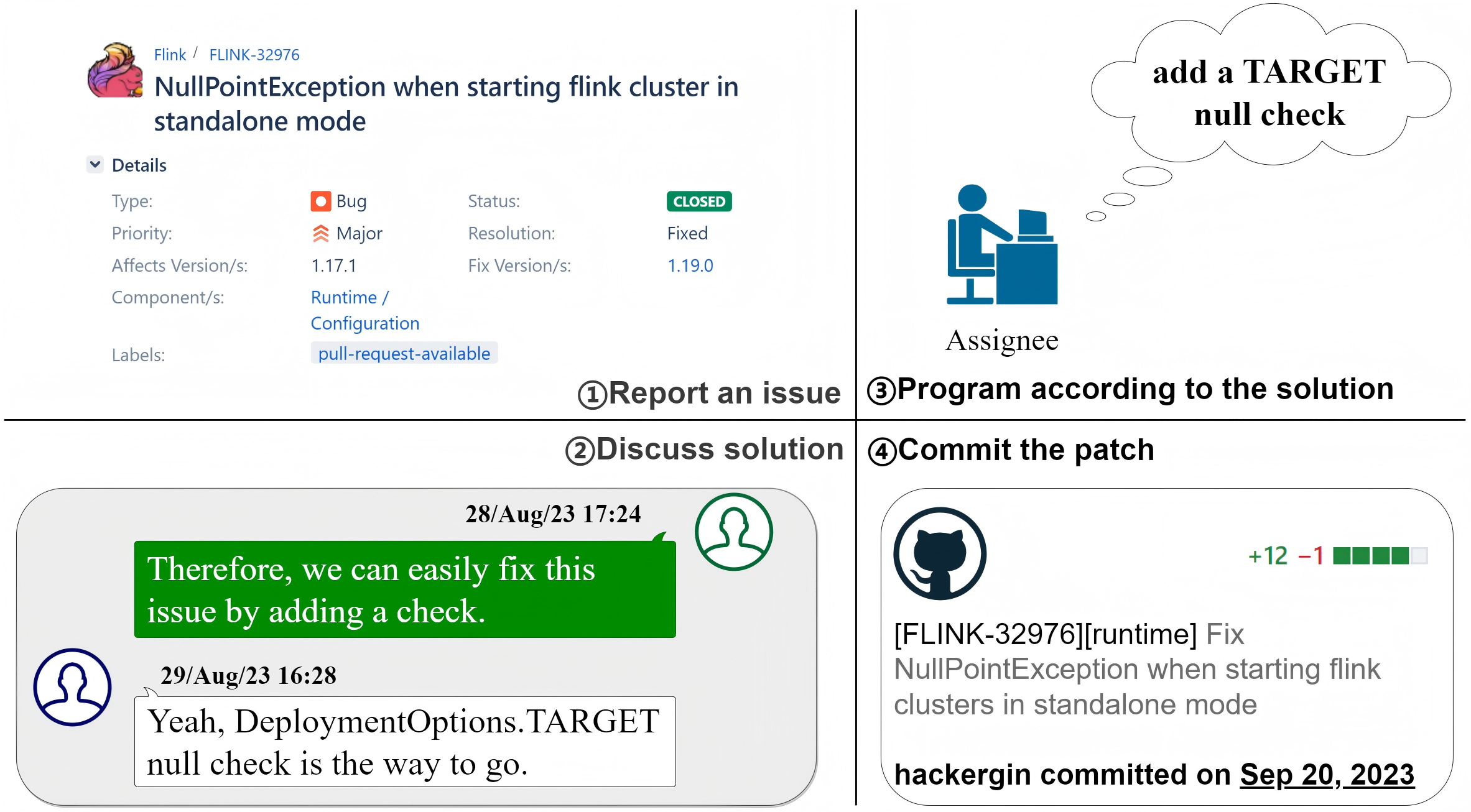
Automatic Program Repair (APR) endeavors to autonomously rectify issues within specific projects, which generally encompasses three categories of tasks: bug resolution, new feature development, and feature enhancement. Despite extensive research proposing various methodologies, their efficacy in addressing real issues remains unsatisfactory. It’s worth noting that, typically, engineers have design rationales (DR) on solution— planed solutions and a set of underlying reasons—before they start patching code. In open-source projects, these DRs are frequently captured in issue logs through project management tools like Jira. This raises a compelling question: How can we leverage DR scattered across the issue logs to efficiently enhance APR?To investigate this premise, we introduce DRCodePilot, an approach designed to augment GPT-4-Turbo’s APR capabilities by incorporating DR into the prompt instruction. Furthermore, given GPT-4’s constraints in fully grasping the broader project context and occasional shortcomings in generating precise identifiers, we have devised a feedback-based self-reflective framework, in which we prompt GPT-4 to reconsider and refine its outputs by referencing a provided patch and suggested identifiers. We have established a benchmark comprising 938 issue-patch pairs sourced from two open-source repositories hosted on GitHub and Jira. Our experimental results are impressive: DRCodePilot achieves a full-match ratio that is a remarkable 4.7x higher than when GPT-4 is utilized directly. Additionally, the CodeBLEU scores also exhibit promising enhancements. Moreover, our findings reveal that the standalone application of DR can yield promising increase in the full-match ratio across CodeLlama, GPT-3.5, and GPT-4 within our benchmark suite. We believe that our DRCodePilot initiative heralds a novel human-in-the-loop avenue for advancing the field of APR.
- DRMiner: Extracting Latent Design Rationale from Jira Issue LogsJiuang Zhao, Zitian Yang, Li Zhang, and 3 more authorsIn Proceedings of the 39th IEEE/ACM International Conference on Automated Software Engineering, Sacramento, CA, USA, 2024
Software architectures are usually meticulously designed to address multiple quality concerns and support long-term maintenance. However, there may be a lack of motivation for developers to document design rationales (i.e., the design alternatives and the underlying arguments for making or rejecting decisions) when they will not gain immediate benefit, resulting in a lack of standard capture of these rationales. With the turnover of developers, the architecture inevitably becomes eroded. This issue has motivated a number of studies to extract design knowledge from open-source communities in recent years. Unfortunately, none of the existing research has successfully extracted solutions alone with their corresponding arguments due to challenges such as the intricate semantics of online discussions and the lack of benchmarks for design rationale extraction.In this paper, we propose a novel approach, named DRMiner, to automatically mine latent design rationales from developers’ live discussion in open-source community (i.e., issue logs in Jira). To better identify solutions and their relevant arguments, DRMiner skillfully decomposes the problem into multiple text classification tasks and tackles them using prompt tuning of large language models (LLMs) and specific heuristic features. To evaluate DRMiner, we acquire issue logs from Cassandra, Flink, and Solr repositories in Jira and form a dataset for design rationale mining. Experimental results show that DRMiner outperforms all baselines and achieves F1 improvements of 24%, 22%, and 20% for mining design rationales, solutions, and arguments, respectively, compared to the best baseline. Furthermore, we investigate the usefulness of the design rationales mined by DRMiner for automated program repair (APR) and find that advanced LLMs, when prompted with these extracted rationales, generate 10×–18× more full-match patches and achieve a 10%-13% gain in CodeBLEU scores.